
Images

click on images to see them enlarge
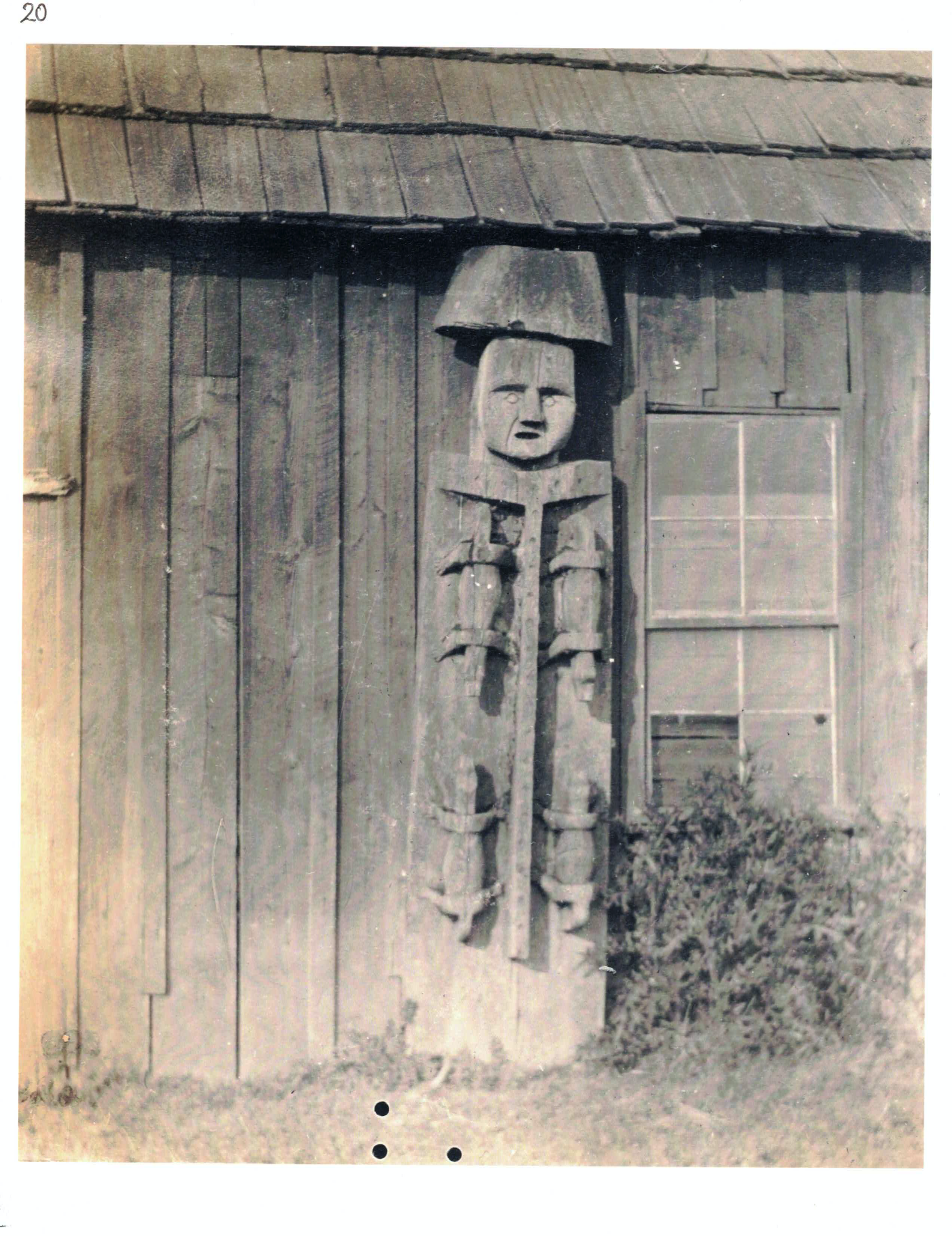
- Title: qequn’ ’utl’ qwuyuxwuthut | House Post of qwuyuxwuthut
- Title spoken by: Pul-hwuletse’ | Wayne Charlie
- Description: Images of house posts from Edward Paul’s Longhouse, dating from 1914-1918.
hwuhwilmuhw knowledge
- Speaker/Story Teller: Sti’tuma’t | Ruby Peter (Kwa’mutsun Elder)
- Date of recording:
- Listen to the recording in Hul’q’umi’num’:
sya’isa’qw tthu sxt’ekw’ | The carving with the hat
- ’een’thu sti’tum’atulwut tun’ni’ tsun ’utl’ kwa’mutsun.
I’m Ruby Peter from Quamichan. - nilh tthu shxaatth’ustun sxt’ek’w ’i’ nilh swe’ ’utl’ qwayuxwuthut Edward Paul.
This is a picture of a carving that belongs to Edward Paul (quxuwuthut). - tun’ni’ ’utl’ kwa’mutsun tthu qwayuxwuthut,
Edward Paul was from Quamichan. - statul’us ’utl’ qu’eeq ’i’ ’uwu te’ me’mun’us.
His wife was qu’eq and they had no children. - ’uw’ tsqule’uq yey’sul’u William Paul [chq’un] ’i’ shmulqwilum
Edward Paul had two younger brothers—William Paul and shmulqwilum. - ’i’ nilh tthu qwayuxwuthut nilh ni’ xt’ekw’t tthu xpey’.
It was Edward Paul that carved that cedar. - sht’eewun’ tsun ’iilh t’xum kwthey’ xpey’ ni’ xt’ekw’tus.
I think there were six cedar carvings that he carved. - kwun’eemst-hwus ’u tthu sq’eetl’ tthu ni’ xt’ekw’tus.
The carving he made is holwind a river otter. - sya’isa’qw ’u kwthu … ’uw’ st’i’am’stum’ tthu yasa’qws.
He’s wearing a hat…he attached a hat on him. - ’i’ nuw’ tl’lim ’uw’ mustimuhw ’i’ nilh kwsus st’e ’u tthey’ kwun’etus tthu sq’eetl’.
And there are several men that look like they are holding river otters. - ’i’ nilh ha’kwushus tthu hwulmuhw tthu sq’eetl’ ’u tthuw’ mukw’ ’ul’ stem.
The river otter was used in many different ways by the First Nations people. - ha’ ni’ kwunnuhwus tthu sq’eetl’ ’i’ ni’ hwtth’a’tus ’i’ ni’ hakwushus ’u kwthu stem ’ul’ ni’ stl’is kws thuyt-s.
If an otter was caught, it would be skinned and the skin would be used for whatever they wanted to make. - ’uwu te’ shtatul’stuhw tst ’uw’ niis hwtsel kwthu sxt’ekw’.
We don’t know where all the carvings went to. - ni’ ’u kwthu ’apun ’i’ kw’ toohw lhq’utsulhshe’ ’iilh ’uw’ hwun’ ’i ’ utl’ kwa’mustun ’iilh ’uw’ hwun’ thuthi’ lhu thi lelum’.
In 1950s they were all still here at Quamichan. - ’i’ ni’ wulh q’ay tthu qwayuxwuthut,
Edward Paul had been dead for a while. - ’i’ niilh ni’ ’u kwthu ’apun ’i’ kw’ toohw t’xumulhshe’, ’i’ ’uwu te’ shtatul’ste’wut ’uw’ nilh ’us lhwet kw’u ni’ ts-hwayum, ’u kwthey’ mukw’ sxt’ekw’.
It was in 1960s that they disappeared and no one knows who sold them. - nuw’ tth’uw ’ul’ ’uwu te’ shtatul’ste’wut ’uw’ niis tstamut.
They just disappeared from the walls of the long house, and no one knows what happened. - ’i’ nilh tun’a qe’is ’i’ ni’ tst tul’nuhw kwus ni’ ’utl’ sqwxwa’mush kwthu nuts’a’.
It was just recently that we found out that one of the carvings was in Vancouver. - ’i’ hay kwthu sq’uq’a’s ’uwu te’ shtatul’stuhw tst ’uw’ niis tstamut.
But we don’t know where the rest are. - ni’ hay.
The end
Key information
- Time period or Date: 1910s
- Theme(s): Totems and House Posts, Buildings, Villages
- Location: Quamichan Village
- Source info (type – name): Museum — Cowichan Valley Museum & Archives
- Photographer credit: J. W. Dickinson (possibly)
- Individuals identified: N/A
Learn more
About House Posts in Kwa’mutsum
Five house posts from this Cowichan shaman’s longhouse in the Coast Salish village of Qw’umqwiimut tell of the abilities and powers of his family members.
The posts supported the roof beams inside the house of Puykwilum, a respected tsuwmun (doctor, or shaman) who did many good deeds for his people. They informed people about the family that the house belonged to. The different figures told of the abilities, or powers, that the family members had acquired through inheritance and earned through study. They were a source of great pride, and were thought-provoking company, with many stories to tell.
The Kwa’mutsum village of Qw’umqwiimut, where these house posts were created, was on Cowichan Creek near the present-day city of Duncan on the east coast of Vancouver Island.

Puykwilum’s house had stood for a long time at the end of the village beside Cowichan Creek. When the house collapsed about 1903, the posts were moved to an adjacent house owned by his son Edward Paul and installed on the outside walls. Over time, changes were made to the house and to the posts.

There is more information about the posts as well as more photographs here: https://totems.royalbcmuseum.bc.ca/en/story/Puykwilum
The posts were acquired by Mr. and Mrs. Corfield and erected near their store, The Canoe, in the 1930s
Related images
Related images to come.
Leave a Reply