
Images
click on images to see them enlarge
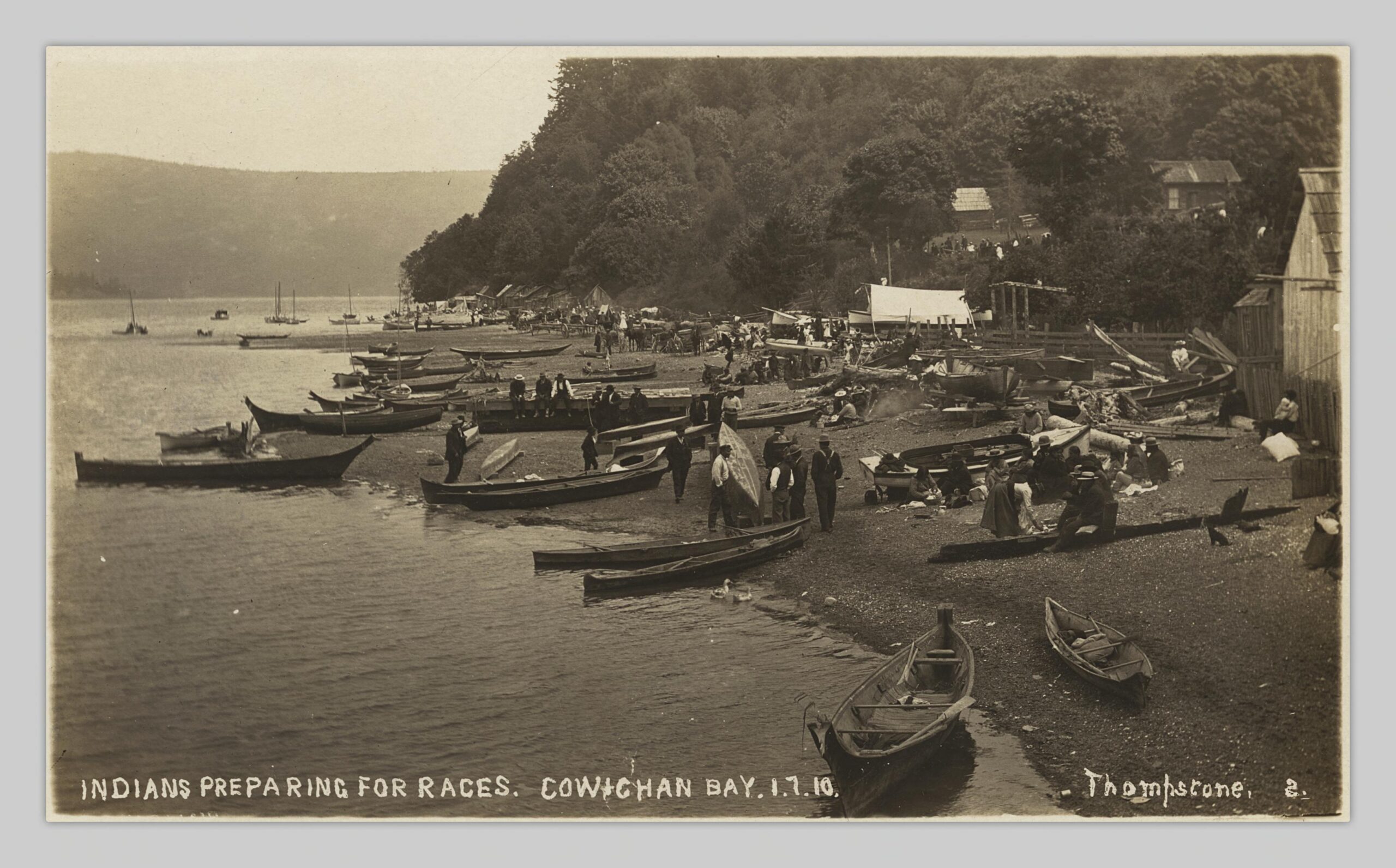
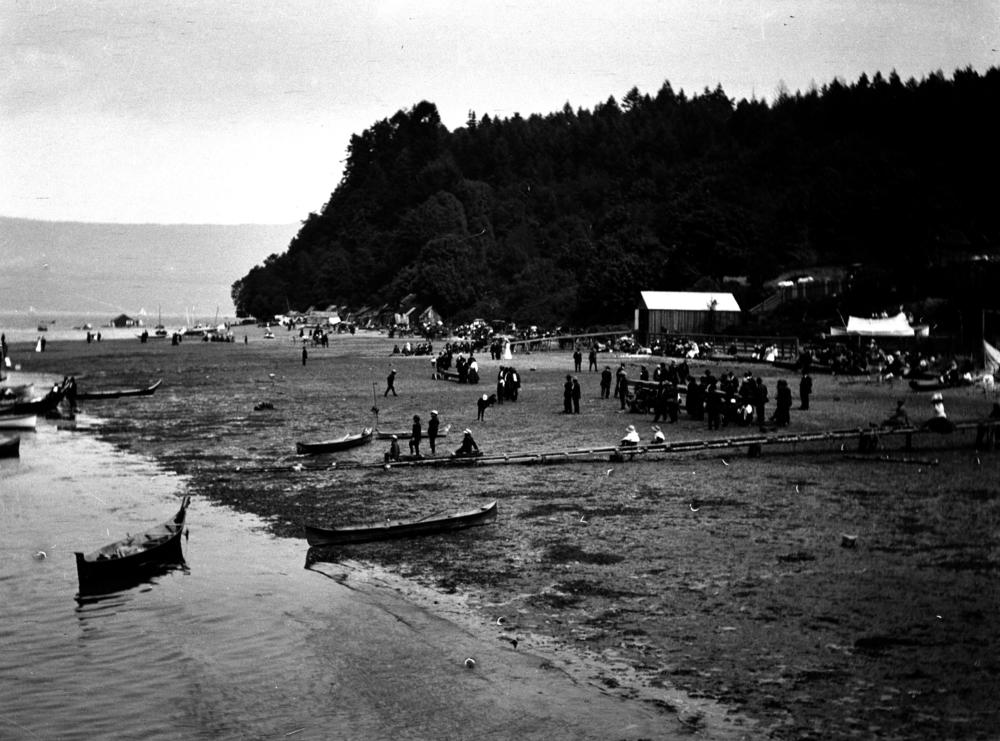
- Title: tuyuwulh ni’ ’u tthu tl’ulpalus | Race Canoes at Cowichan Bay
- Description: Shoreline view of Cowichan village showing many canoes, possibly preparing for a canoe race, which were popular at the time.
hwuhwilmuhw knowledge
- Speaker/Story Teller: —
- Date of recording: —
- Listen to the recording in Hul’q’umi’num’:
Audio currently unavailable
Key information
- Time period or Date: 1912
- Theme(s): Villages, Canoes and Boats, Canoe Races
- Location: Ti’ulpalus’ Village
- Source info (type – name): Museum — Cowichan Valley Museum & Archives
- Photographer credit: Mark William Thompstone
- Individuals identified: N/A
Learn more
Cowichan Bay Canoe Races
Indigenous canoe races have long been a popular summer event in the Tl’ulpalus (Cowichan Bay) waters. In the early 20th century, Indigenous paddlers and non-Indigenous spectators came great distances to watch or participate in these races. Boats were anchored in the bay and canoes filled the shoreline. Large crowds would gather at this formal event, with local dignitaries handing out prizes and trophies.
Sometime between 1890 and 1910 the larger traditional canoes fell out of favour for racing and local boat builders like Marshall Harry (1877-Dec.7, 1958) and Edwin Underwood developed a new style of racing canoe that merged a long English racing canoe with local Indigenous designs.1 These canoes were often called “War canoes” in the newspapers.
By the 1920s, Indigenous communities were organizing our own races, many of which continue today. Today’s canoe races carry on a tradition that has been part of our way of life since time immemorial. The races take place in late spring through to the end of summer in communities throughout Coast Salish territory. A celebration of culture and paddling skill, the races thrill spectators and participants alike.
About tl’ulpalus
Tl’ulpalus, also written as Kilpahlis or Kil-pah-las, is one of seven traditional villages of Quw’utsun Tribes. It makes up Cowichan Reserve #3.
The winter village of Tl’ulpalus once extended from the present Government Wharf in Cowichan Bay to the present reserve at the south end of Cowichan Bay. It was an important transportation hub and Traditional Land Use (TLU) site.
Traditionally, Tl’ulpalus was an important resource site for Quw’utsun people. The waterways were used for fishing almost year round and in the spring, herring roe was collected and the fish were “raked” in large numbers. There were also many types of beach foods harvested at this site including clams, cockles, crabs, and urchin. Harbour seals and sea lions were found here in large numbers and were hunted by Quw’utsun people.2 Waterfowl were abundant and were also hunted. Today, much of the area is polluted by industry and traditional food resources like shellfish are closed to harvesting.
Tl’ulpalus remains an important place for Quw’utsun mustimuwh. It is valued not just as a resource site but also for cultural and spiritual purposes. The Quw’utsun Tribes canoe shed is built on this reserve and the waters of Tl’ulpalus are where the War Canoe races typically occur.3 Tl’ulpalus is also an important transformer site. It was here that Xeel’s, the transformer, turned a man to stone for not heeding the warnings of his fellow villagers to run for cover as Xeel’s traveled through the bay. Transformed into stone, this rock serves as a cautionary tale to children who are warned not to play around “deaf rock” lest they lose their gift of hearing.4
Footnotes
- See Grant Keddie, “Indigenous Canoe Racing on the Gorge Waterway,” https://grantkeddie.com/2024/09/indigenous-canoe-racing-on-the-gorge-waterway/
- David Rozen, “Place-names of the Island Halkomelem Indian People, MA Thesis, 1985, p.226-227.
- Cowichan Tribes, https://cowichantribes.com/application/files/9216/5896/0044/August_Newsletter_07.06.2022_Final.pdf
- Marshall, Those Who Fell From the Sky, p.42.
Related images
Related images to come.
Leave a Reply